The Taj Mahal: A Timeless Symbol of Love and Heritage
The Taj Mahal is one of the most famous monuments in the world and a shining symbol of India’s rich cultural heritage. Located on the banks of the Yamuna River in Agra, Uttar Pradesh, the Taj Mahal is admired for its breathtaking beauty, architectural excellence, and deep emotional significance. Built in the 17th century by the Mughal Emperor Shah Jahan, this magnificent monument continues to attract millions of visitors from across the globe and stands as an enduring symbol of love.
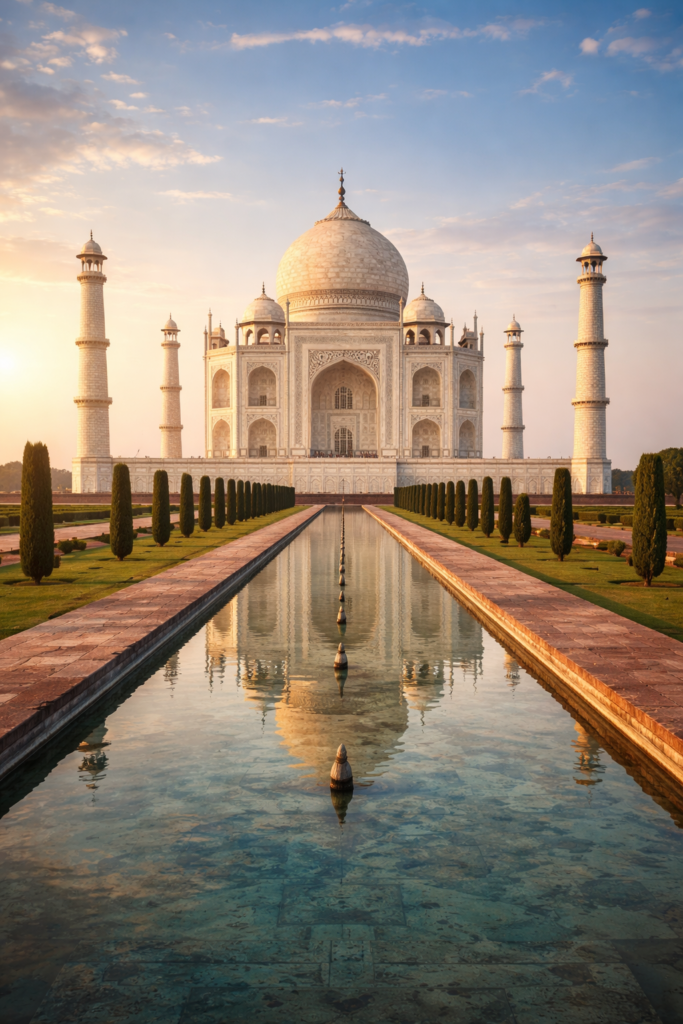
The Taj Mahal was constructed between 1632 and 1653 in memory of Mumtaz Mahal, the beloved wife of Shah Jahan. Mumtaz Mahal died while giving birth to their fourteenth child, and her death deeply affected the emperor. To honor her memory and express his undying love, Shah Jahan decided to build a mausoleum unlike any the world had ever seen. The result was the Taj Mahal, a monument that blends emotion, art, and architecture into a single masterpiece.
Architecturally, the Taj Mahal is a perfect example of Mughal architecture, which combines elements from Islamic, Persian, Ottoman Turkish, and Indian styles. The monument is built primarily from white marble brought from Makrana in Rajasthan. Its large central dome, flanked by four smaller domes, rises gracefully above the structure, giving it a sense of balance and harmony. Four tall minarets stand at each corner of the platform, slightly tilted outward to protect the main tomb in case of an earthquake.
One of the most striking features of the Taj Mahal is its symmetry. Every element of the complex is carefully planned and perfectly aligned, from the main mausoleum to the gardens and pathways. The Charbagh-style garden, divided into four equal parts by water channels, represents the Islamic concept of paradise. The reflection of the Taj Mahal in the long central pool enhances its beauty and creates a magical visual effect, especially at sunrise and sunset.
The interior of the Taj Mahal is equally impressive. Inside the main chamber lie the cenotaphs of Mumtaz Mahal and Shah Jahan, decorated with intricate carvings and precious stones. The actual graves are located in a lower chamber, following Islamic tradition. The walls are adorned with beautiful calligraphy from the Quran and delicate floral designs made using a technique known as pietra dura, where semi-precious stones are inlaid into marble.
The Taj Mahal is not only an architectural marvel but also a symbol of love and devotion. It represents Shah Jahan’s grief and his desire to immortalize his wife’s memory. Over the centuries, the monument has come to symbolize eternal love, inspiring poets, artists, and writers from around the world. Its beauty transcends time and culture, making it a universal icon of romance.
In 1983, the Taj Mahal was declared a UNESCO World Heritage Site in recognition of its outstanding cultural value. It is also considered one of the Seven Wonders of the Modern World. Despite its fame, the monument faces several challenges, including pollution, environmental damage, and the effects of time. Efforts by the Indian government and international organizations are ongoing to preserve and protect this priceless treasure for future generations.
The Taj Mahal holds immense importance for India’s tourism and economy. It is one of the most visited monuments in the country, attracting tourists, historians, architects, and photographers alike. For many visitors, seeing the Taj Mahal is a lifelong dream, and its serene presence leaves a lasting impression on all who witness it.
In conclusion, the Taj Mahal is much more than a marble monument; it is a symbol of love, art, and human creativity at its finest. Its flawless architecture, rich history, and emotional depth make it one of the greatest achievements of world heritage. Standing gracefully on the banks of the Yamuna, the Taj Mahal continues to inspire awe and admiration, reminding humanity that love and beauty can truly be eternal.
Leave a Reply