🇻🇪 Introduction: Geographic and Demographic Overview
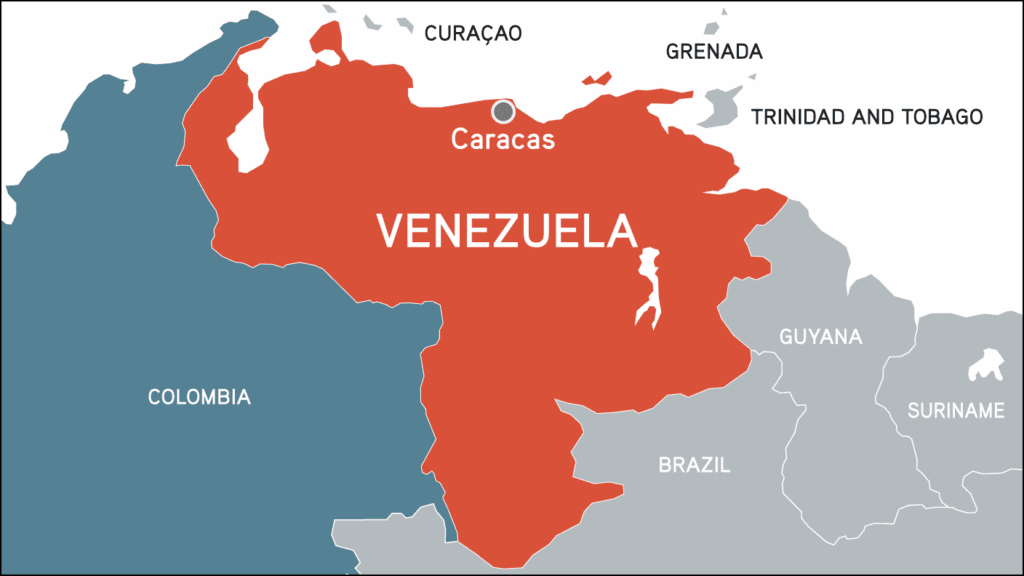
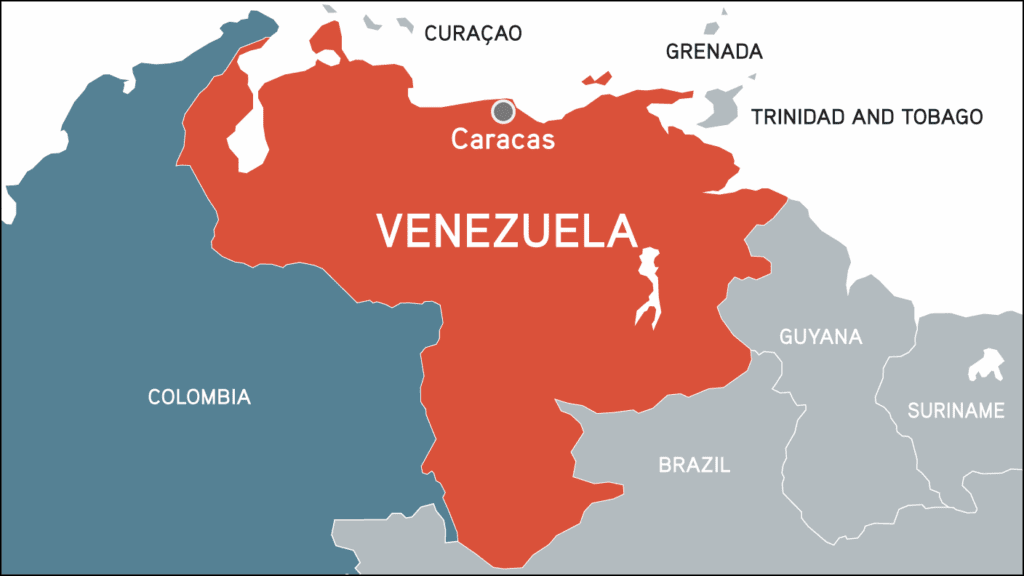
Venezuela, officially the Bolivarian Republic of Venezuela, is a country on the northern coast of South America, bordered by the Caribbean Sea and Atlantic Ocean to the north, Guyana to the east, Brazil to the south, and Colombia to the west and southwest. Its capital and largest city is Caracas. Venezuela also administers several Caribbean islands and archipelagos, including Margarita Island and Los Roques.
With a population of roughly 34 million people (2025 estimate), Venezuela is a culturally diverse nation shaped by Indigenous, African, and European influences. Spanish is the official language, and Roman Catholicism is the dominant religion.
🧭 Historical Background
Pre-Colonial and Colonial Era
Long before Spanish arrival in 1498, the region was inhabited by Indigenous groups, including Arawak and Carib peoples. After Christopher Columbus reached the area under the Spanish flag, Venezuela became part of the Spanish Empire, centered around extractive colonial institutions.
Independence and Early Republic
Venezuela was among the first Spanish colonies in the Americas to seek independence. After protracted military campaigns, the country formally broke from Spain in the early 19th century, laying the foundation for republican institutions — though this period was marked by recurring instability, caudillo leadership, and regional power struggles.
20th Century: Oil and Transformation
The discovery of oil in the early 20th century transformed Venezuela’s economy and global role. By the mid-1900s, petroleum revenues helped modernize infrastructure and urbanize society. Venezuela became one of Latin America’s most prosperous nations and, for a period in the 1950s and 1970s, one of the world’s wealthiest in GDP per capita terms.
In 1958, a democratic transition ended decades of military rule, ushering in a period of relative political stability and democratic competition — unusual in the region at the time.
🏛️ Politics and Governance
Bolivarian Revolution and Chávez
The late 20th century was marked by recurrent economic crises and disappointment with traditional political parties. In 1998, Hugo Chávez, a charismatic former army officer, was elected president and launched the Bolivarian Revolution, named after Venezuelan independence hero Simón Bolívar. This movement aimed to redistribute wealth, expand social programs, and reduce U.S. influence. Chávez drafted a new constitution in 1999 that centralized executive powers, expanded state control of key sectors (especially oil), and rebranded the nation as the Bolivarian Republic of Venezuela.
Maduro Era and Democratic Backsliding
Chávez’s successor, Nicolás Maduro, continued and intensified these policies after Chávez’s death in 2013. Over time, Venezuela’s political system eroded democratic norms: elections were widely criticized as neither free nor fair, opposition figures were harassed or barred, and checks and balances weakened considerably. Many observers now describe Venezuela’s governance as authoritarian, despite its nominal republican structures.
Corruption has been endemic, with Venezuela ranking among the most corrupt countries globally according to major indices. This has deeply weakened state institutions, undermined economic performance, and eroded public trust.
📉 Economic Rise and Collapse
Oil Dependency and Early Prosperity
Venezuela has the largest proven oil reserves in the world, estimated at around 303 billion barrels. For much of the 20th century, oil export revenue funded social programs and infrastructure growth and helped fuel economic expansion.
For decades, oil accounted for the vast majority of government revenue and export receipts, creating deep dependency. When global oil prices were high, the economy boomed; when prices fell, fiscal strain intensified. This “resource curse” dynamic became more acute over time.
Collapse of the Economy (2014–Present)
From around 2014 onwards, Venezuela’s economy imploded due to a combination of mismanagement, falling oil prices, corruption, and increasingly severe international sanctions. GDP contracted sharply, public services deteriorated, and hyperinflation ravaged living standards — among the worst in modern history.
Annual inflation skyrocketed in preceding years, reaching levels that made the bolívar nearly worthless, with widespread shortages of food, medicine, electricity, and basic goods. Even before 2026, poverty and displacement reached historic heights, with millions of Venezuelans fleeing the country over roughly a decade.
Attempts at economic reforms, including partial market-oriented measures in the early 2020s, brought some stabilization, but structural weaknesses remained.
Oil Industry Decline
Despite having enormous reserves, Venezuela’s oil production plunged from a peak of over 3.5 million barrels per day in the late 1990s to well below 1 million by the mid-2020s. Causes include technical difficulties, mismanagement, sanctions, lack of investment, and an exodus of skilled workers after major changes at the state oil company PDVSA.
📌 Contemporary Political Crisis (2025–2026)
A defining recent event occurred in January 2026, when the United States conducted a military operation in Caracas and captured President Nicolás Maduro along with his wife — a development that shocked the international community. The U.S. justified the intervention under allegations of “narco-terrorism” and long-standing disputes over Venezuela’s oil assets, while critics condemned the move as illegal and imperialist.
Following Maduro’s capture, Delcy Rodríguez was installed as interim president with U.S. backing — a controversial transition that deepened global divides. The U.S. has signaled plans to aid in revitalizing Venezuela’s energy sector by involving American companies in oil production, while maintaining pressure on political reform.
Economically, sanctions and partial blockades have further destabilized Venezuela’s financial system, causing currency devaluation and renewed inflationary pressures in early 2026.
International reaction has been mixed: some governments and human rights advocates criticize the legitimacy of the intervention, while others support efforts toward a transitional government and free elections. Venezuela’s future direction — whether towards democratic reforms, continued instability, or contested governance — remains uncertain.
🧑🤝🧑 Society and Culture
Despite prolonged turmoil, Venezuela retains a rich cultural heritage. Venezuelan music, dance, literature, and culinary traditions reflect a blend of Indigenous, African, and Spanish influences. Staples like arepas (cornmeal patties), cachapas, and sancocho (stew) are iconic elements of the national cuisine, while musical genres such as salsa, merengue, and joropo showcase lively rhythms and artistic diversity.
The crisis, however, has had devastating social effects: widespread poverty, shortages of essential services, and mass emigration have reshaped Venezuelan communities at home and abroad.
📍 Foreign Relations and Global Context
Venezuela’s foreign policy has traditionally aligned with several non-Western states and left-leaning governments, cultivating ties with Russia, China, Iran, and Cuba in sectors ranging from energy to security cooperation. Venezuala was a founding member of the International Monetary Fund in 1946 but has had an uneven relationship with international financial institutions amid its economic crises.
Relations with the United States were historically contentious, marked by disputes over oil nationalization, trade sanctions, and diplomatic standoffs — culminating in the dramatic events of early 2026.
🧾 Conclusion: A Nation at a Crossroads
Venezuela’s story is one of dramatic contrasts: from oil boom prosperity to near-state collapse; from democratic promise to authoritarian drift; from global economic relevance to humanitarian crisis. Its future trajectory will depend on how political transitions unfold, whether comprehensive economic reforms are implemented, and how the Venezuelan people — many of whom now live abroad — engage with national rebuilding.
Despite immense challenges, Venezuela remains a country of vast natural wealth, deep cultural roots, and significant geopolitical importance. Its next chapter could redefine not just its own destiny but also influence broader debates about governance, resource management, and international engagement in the 21st century.