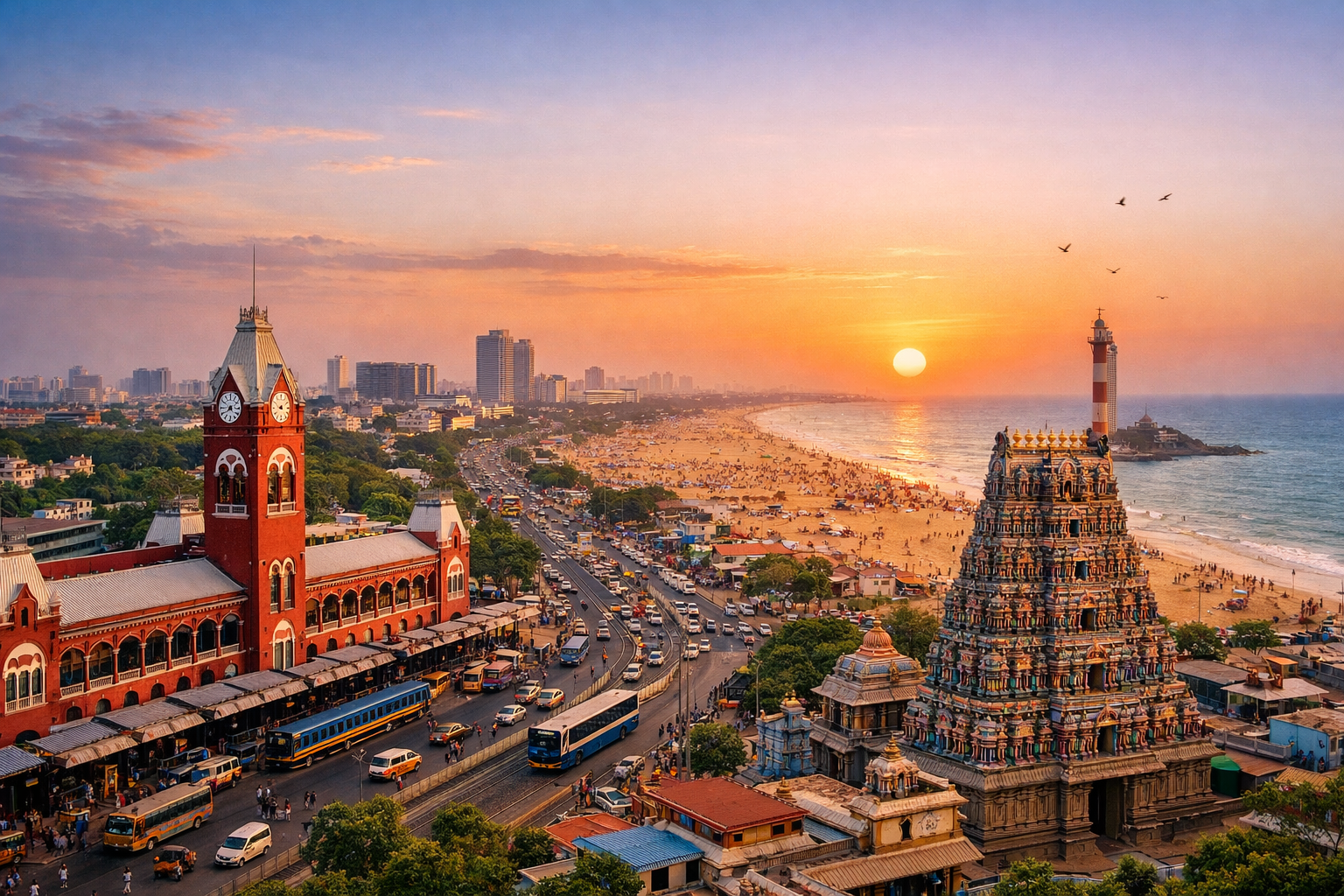
Chennai: The Cultural, Economic, and Historical Capital of South India
Chennai, formerly known as Madras, is the capital city of the Indian state of Tamil Nadu and one of the most important metropolitan cities in India. Located on the Coromandel Coast along the Bay of Bengal, Chennai is often referred to as the “Gateway to South India.” It is a city where ancient traditions coexist harmoniously with modern development, making it a unique blend of history, culture, education, industry, and technology. With a rich heritage dating back thousands of years and a rapidly growing urban landscape, Chennai stands as a symbol of South India’s identity and progress.
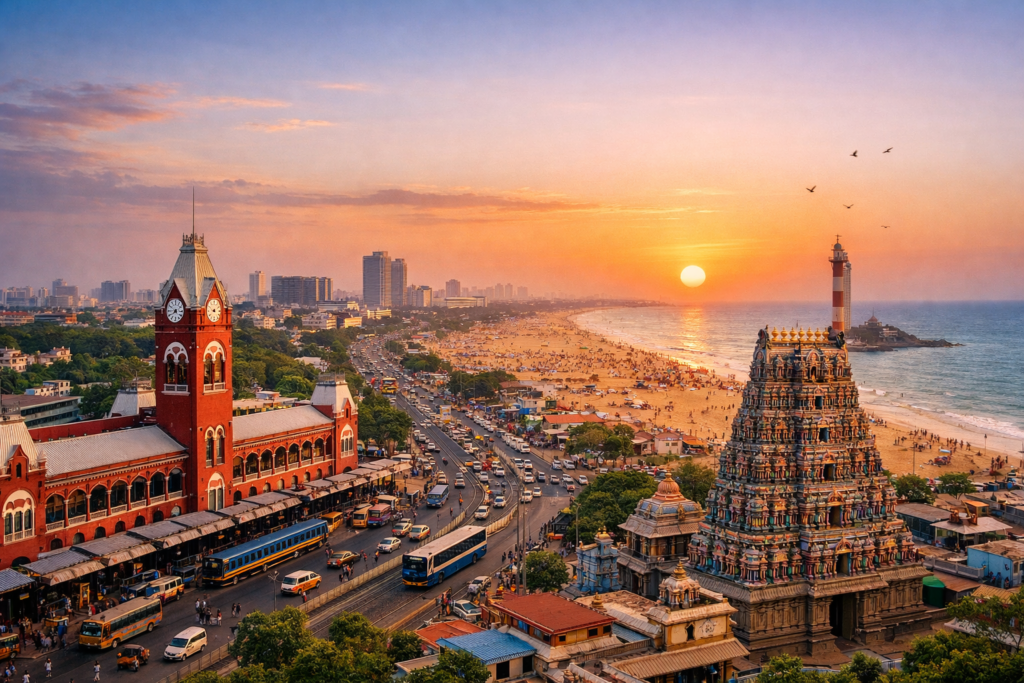
Historical Background
The history of Chennai is deeply rooted in ancient South Indian civilizations. The region around present-day Chennai was part of powerful South Indian dynasties such as the Pallavas, Cholas, Pandyas, and later the Vijayanagara Empire. These rulers contributed significantly to Tamil art, architecture, literature, and administration. The nearby town of Mahabalipuram, a UNESCO World Heritage Site, is a fine example of Pallava architecture and reflects the region’s historical importance.
Chennai’s modern history began in 1639 when the British East India Company established Fort St. George after acquiring land from local rulers. This marked the foundation of the city as a major colonial center. Under British rule, Chennai developed into an important administrative, military, and commercial hub. The colonial influence is still visible today in buildings such as Fort St. George, the Madras High Court, Ripon Building, and various churches and educational institutions. After India gained independence in 1947, Chennai emerged as a key city in shaping modern Tamil Nadu.
Geography and Climate
Chennai is situated on the southeastern coast of India and is characterized by flat coastal plains. The city is crisscrossed by rivers such as the Cooum and Adyar, though urbanization has affected their natural flow and cleanliness. The Bay of Bengal plays a crucial role in shaping Chennai’s climate and economy.
The climate of Chennai is tropical, with hot and humid weather prevailing for most of the year. Summers are particularly intense, with temperatures often exceeding 40°C. The city receives most of its rainfall from the northeast monsoon between October and December, unlike many other parts of India that depend on the southwest monsoon. Cyclones and heavy rains occasionally affect the city, highlighting the challenges of coastal urban living.
Cultural Heritage and Traditions
Chennai is widely regarded as the cultural capital of South India. Tamil language, one of the oldest classical languages in the world, is at the heart of the city’s identity. Tamil literature, poetry, music, and dance have flourished here for centuries. The city is a major center for Carnatic music and Bharatanatyam dance, both of which are integral to South Indian classical traditions.
The annual Madras Music Season, held during December and January, attracts artists and audiences from across the globe. During this time, numerous concerts, dance performances, and cultural events take place throughout the city. Chennai’s strong cultural roots are also reflected in its temples, such as Kapaleeshwarar Temple in Mylapore and Parthasarathy Temple in Triplicane, which are not only places of worship but also centers of art and community life.
Festivals are celebrated with great enthusiasm in Chennai. Pongal, the harvest festival of Tamil Nadu, is one of the most important celebrations and symbolizes gratitude to nature. Other festivals like Deepavali, Navaratri, and Tamil New Year further highlight the city’s vibrant cultural life.
Economy and Industrial Growth
Chennai is one of India’s major economic centers and plays a crucial role in the country’s industrial and commercial development. The city is often called the “Detroit of India” due to its strong automobile industry. Several major automobile manufacturers and auto-component companies have established production units in and around Chennai, making it a global automotive hub.
In addition to automobiles, Chennai has a diversified economy that includes information technology, electronics, healthcare, manufacturing, logistics, and finance. The city is home to several IT parks and technology corridors, such as those along Old Mahabalipuram Road (OMR), which house multinational companies and startups. Chennai’s ports—Chennai Port, Ennore Port, and Kattupalli Port—are among the busiest in India and play a vital role in international trade.
The healthcare sector in Chennai is particularly noteworthy. The city is known as the “Health Capital of India” due to its advanced medical facilities, skilled doctors, and affordable treatment options. Patients from across India and abroad travel to Chennai for specialized medical care, contributing to the city’s medical tourism industry.
Education and Knowledge Hub
Education has always been a cornerstone of Chennai’s development. The city is home to some of India’s most prestigious educational institutions, including the University of Madras, Indian Institute of Technology Madras (IIT Madras), Anna University, and several renowned schools and research centers. These institutions have produced scholars, scientists, engineers, and leaders who have contributed significantly to India and the world.
Chennai’s emphasis on education has helped create a skilled workforce that supports its industries and innovation ecosystem. Libraries, research institutions, and cultural organizations further strengthen the city’s reputation as a center of learning and intellectual growth.
Urban Life and Infrastructure
As a major metropolitan city, Chennai has experienced rapid urbanization over the past few decades. The city’s infrastructure includes an extensive road network, suburban railway system, metro rail, and bus services that connect different parts of the city and surrounding regions. Chennai International Airport is one of the busiest airports in India and serves as a key gateway for international and domestic travel.
Despite its development, Chennai faces challenges common to large cities, such as traffic congestion, water scarcity, pollution, and the need for sustainable urban planning. Efforts are being made to improve infrastructure, promote public transportation, restore water bodies, and adopt smart city initiatives to enhance the quality of life for residents.
Cuisine and Lifestyle
Chennai’s cuisine reflects its rich cultural heritage and coastal location. South Indian food dominates the culinary landscape, with dishes such as idli, dosa, vada, sambar, rasam, and curd rice being everyday staples. Traditional meals served on banana leaves are a distinctive feature of Tamil culture. Seafood is also popular due to the city’s proximity to the sea.
The lifestyle in Chennai is often described as traditional yet progressive. While modern shopping malls, entertainment centers, and corporate offices are widespread, the city continues to value simplicity, family life, and cultural practices. The people of Chennai are known for their warmth, discipline, and respect for tradition.
Conclusion
Chennai is a city of contrasts and continuity—where ancient temples stand alongside modern skyscrapers, classical music resonates amid technological innovation, and tradition evolves without losing its essence. Its historical significance, cultural richness, economic strength, and educational excellence make Chennai one of India’s most important cities. As it continues to grow and adapt to the challenges of the future, Chennai remains deeply rooted in its Tamil heritage, offering a unique example of how tradition and modernity can thrive together.