Patna, the capital city of the Indian state of Bihar, is one of the oldest continuously inhabited cities in the world. Situated on the southern bank of the sacred river Ganga, Patna has been a major center of political power, education, trade, and culture for more than two thousand years. Known in ancient times as Pataliputra, the city has witnessed the rise and fall of great empires and has played a vital role in shaping Indian history and civilization.
In ancient India, Patna was called Pataliputra and served as the capital of the powerful Magadha Empire. It gained prominence during the reign of kings like Ajatashatru, Chandragupta Maurya, Bindusara, and the great Emperor Ashoka. Under the Mauryan dynasty, Pataliputra became one of the largest and most prosperous cities in the world. Later, it also served as the capital of the Gupta Empire, which is often described as the Golden Age of Indian history due to its achievements in science, art, mathematics, and literature. Famous scholars like Aryabhata are associated with this region, highlighting Patna’s importance as a center of learning.
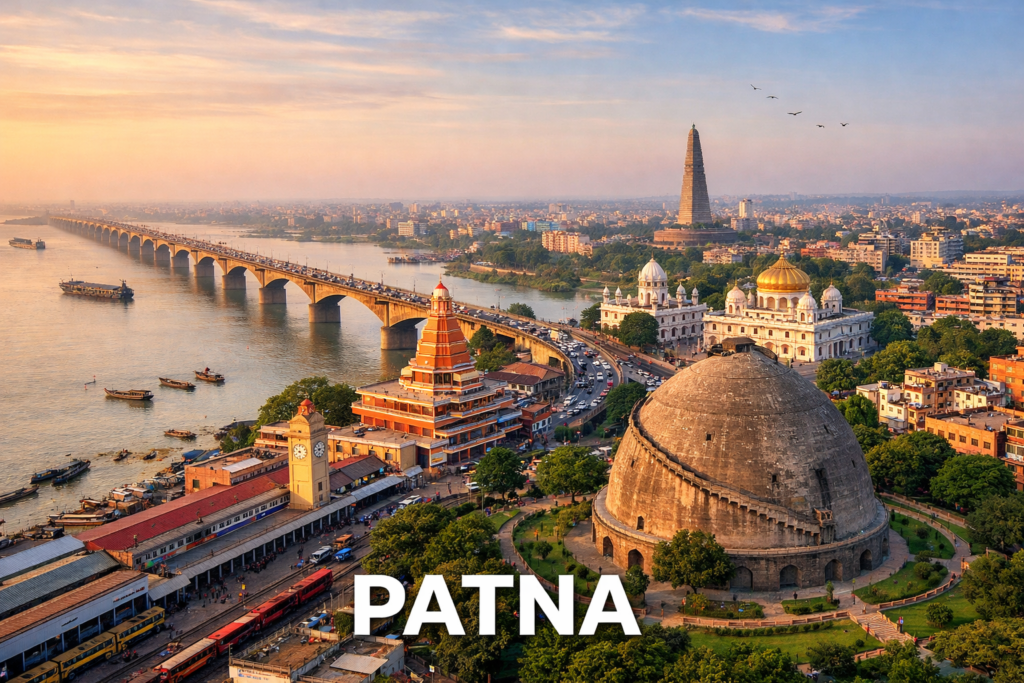
Patna holds immense religious significance for followers of various faiths. For Buddhists, it is closely linked to the life and teachings of Gautama Buddha, who traveled and preached in the Magadha region. Nearby places such as Nalanda and Rajgir were important centers of Buddhist education and spirituality. For Jains, Patna is sacred because it is believed to be the birthplace of Lord Mahavira, the 24th Tirthankara of Jainism, at nearby Vaishali. Sikhism also holds Patna in high regard, as it is the birthplace of Guru Gobind Singh Ji, the tenth Sikh Guru. The Takht Sri Patna Sahib stands as a major pilgrimage site for Sikhs from across the world.
Geographically, Patna is located in the fertile Indo-Gangetic plains, making it an important agricultural and trade center. The city experiences a subtropical climate, with hot summers, a monsoon season bringing moderate to heavy rainfall, and cool winters. The river Ganga not only adds to the city’s natural beauty but has also played a crucial role in its economic and cultural development. Along with the Ganga, rivers like Son, Punpun, and Gandak contribute to the region’s rich alluvial soil, supporting agriculture and livelihoods.
During the medieval period, Patna emerged as a significant trading hub. Under the Mughal Empire, it became famous for its rice, saltpeter, and textile trade. European travelers and traders, including the Portuguese and the British, recognized its commercial importance. In the modern era, Patna played a notable role in India’s freedom struggle. Leaders like Jayaprakash Narayan, Dr. Rajendra Prasad (India’s first President), and Anugrah Narayan Sinha were closely associated with the city and the state of Bihar. The movement led by Jayaprakash Narayan in the 1970s from Bihar had a profound impact on Indian politics.
Culturally, Patna reflects the rich heritage of Bihar. The city is known for its traditional festivals such as Chhath Puja, which is celebrated with great devotion on the banks of the Ganga. Other festivals like Holi, Diwali, Eid, and Durga Puja are celebrated with equal enthusiasm, showcasing the city’s cultural diversity and harmony. Patna’s cuisine is simple yet flavorful, with popular dishes including litti-chokha, sattu paratha, khaja, and thekua, which reflect the agrarian roots of the region.
Modern Patna is a blend of history and development. It is an important center for education, housing institutions like Patna University, NIT Patna, and several medical and professional colleges. The city has seen rapid growth in infrastructure, including better road networks, bridges like the Mahatma Gandhi Setu, and improved public facilities. At the same time, historical landmarks such as Golghar, Kumhrar, Patna Museum, and Agam Kuan continue to attract tourists and historians alike.
In conclusion, Patna is a city where the past and present coexist harmoniously. From being the glorious capital of ancient empires to serving as a modern state capital, Patna has continuously evolved while preserving its rich heritage. Its historical importance, religious significance, cultural vibrancy, and growing modern identity make Patna not just the heart of Bihar, but also one of the most historically meaningful cities in India.
Leave a Reply