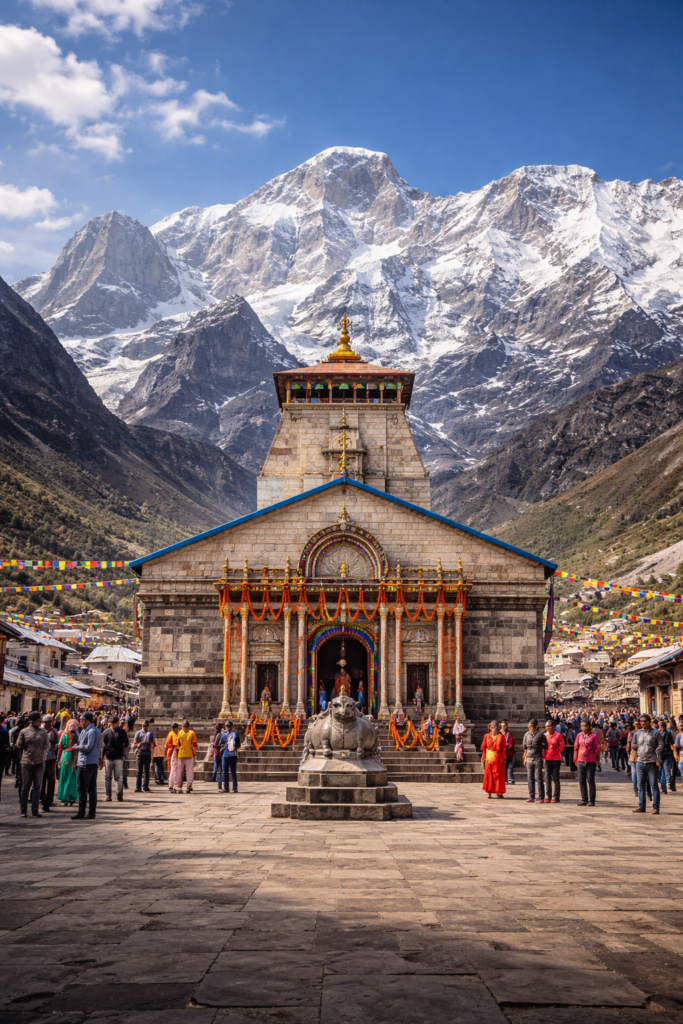
Kedarnath Temple is one of the most revered and ancient Hindu temples in India, dedicated to Lord Shiva. Situated in the Rudraprayag district of Uttarakhand, the temple stands at an elevation of about 3,583 meters (11,755 feet) above sea level, near the banks of the Mandakini River and in the lap of the majestic Garhwal Himalayas. It is one of the twelve Jyotirlingas of Lord Shiva and an important part of the Char Dham Yatra, making it a major pilgrimage destination for devotees from all over the world.
According to Hindu mythology, the origin of Kedarnath Temple is closely associated with the Pandavas from the epic Mahabharata. After the Kurukshetra war, the Pandavas sought forgiveness from Lord Shiva for the sins committed during the war. Lord Shiva, unwilling to forgive them easily, took the form of a bull and tried to evade them. When Bhima recognized him, Shiva dived into the ground, leaving behind parts of his body at different places. The hump appeared at Kedarnath, while other parts appeared at Tungnath, Rudranath, Madhyamaheshwar, and Kalpeshwar, together known as the Panch Kedar. Kedarnath thus holds immense spiritual significance as the place where Lord Shiva manifested in his divine form.
The temple’s architecture is a remarkable example of ancient stone construction. Built using massive grey stone slabs, the temple stands on a rectangular platform and is believed to have been constructed by Adi Shankaracharya in the 8th century, though some legends suggest it is even older, dating back to the time of the Pandavas. The inner sanctum houses a conical-shaped lingam, representing Lord Shiva. The temple complex also includes a statue of Nandi the bull, who faces the sanctum, symbolizing devotion and strength. Despite harsh weather conditions, heavy snowfall, and earthquakes, the temple has stood strong for centuries, reflecting the brilliance of ancient Indian engineering.
Kedarnath Temple is not only a religious site but also a place of breathtaking natural beauty. Surrounded by snow-capped peaks such as the Kedarnath range and lush alpine meadows, the temple offers a serene and spiritual atmosphere. The journey to Kedarnath is considered an act of devotion itself. Pilgrims must trek approximately 16 kilometers from Gaurikund, passing through rugged mountain paths, waterfalls, and scenic landscapes. In recent years, facilities such as pony services, palanquins, and helicopter services have made the journey more accessible.
The temple remains closed during winter due to extreme snowfall and harsh climatic conditions. Usually, it opens in April or May and closes around October or November, depending on the Hindu calendar. During winter, the idol of Lord Shiva is ceremonially moved to Ukshimath, where worship continues. This tradition highlights the deep connection between nature, seasons, and spiritual practices in Hinduism.
The devastating floods of 2013 caused by heavy rainfall and glacial bursts severely affected the Kedarnath region, leading to immense loss of life and property. However, the main temple structure miraculously survived with minimal damage, strengthening the faith of devotees. Since then, significant efforts have been made by the government to improve infrastructure, safety, and disaster management, ensuring a safer pilgrimage experience.
In conclusion, Kedarnath Temple is not merely a place of worship but a symbol of faith, endurance, and spiritual awakening. Its rich mythology, ancient architecture, and awe-inspiring natural surroundings make it a unique and sacred destination. For devotees, visiting Kedarnath is believed to cleanse sins and bring one closer to moksha, or liberation. Even for travelers and nature lovers, Kedarnath offers a profound experience that blends spirituality with the grandeur of the Himalayas, leaving an everlasting impression on the heart and soul.
Leave a Reply