Delhi, the capital of India, is one of the world’s oldest continuously inhabited cities and a place where history and modernity exist side by side. Situated on the banks of the Yamuna River in northern India, Delhi has been a center of political power, culture, trade, and learning for centuries. Its unique character comes from the many empires, dynasties, and communities that have shaped it over time. Today, Delhi stands as a vibrant metropolis, reflecting India’s rich past while driving its future.
Historically, Delhi has held immense significance. It is often said that the city has been built and rebuilt several times, with at least seven major historical cities forming what is now known as Delhi. Ancient texts associate the region with Indraprastha, the capital of the Pandavas in the epic Mahabharata. Over the centuries, Delhi became the seat of power for many rulers, including the Delhi Sultanate, the Mughal Empire, and later the British. Each period left behind remarkable monuments that still define the city’s landscape. Structures such as the Qutub Minar, Red Fort, Humayun’s Tomb, and Jama Masjid are not just architectural masterpieces but also symbols of Delhi’s layered history.
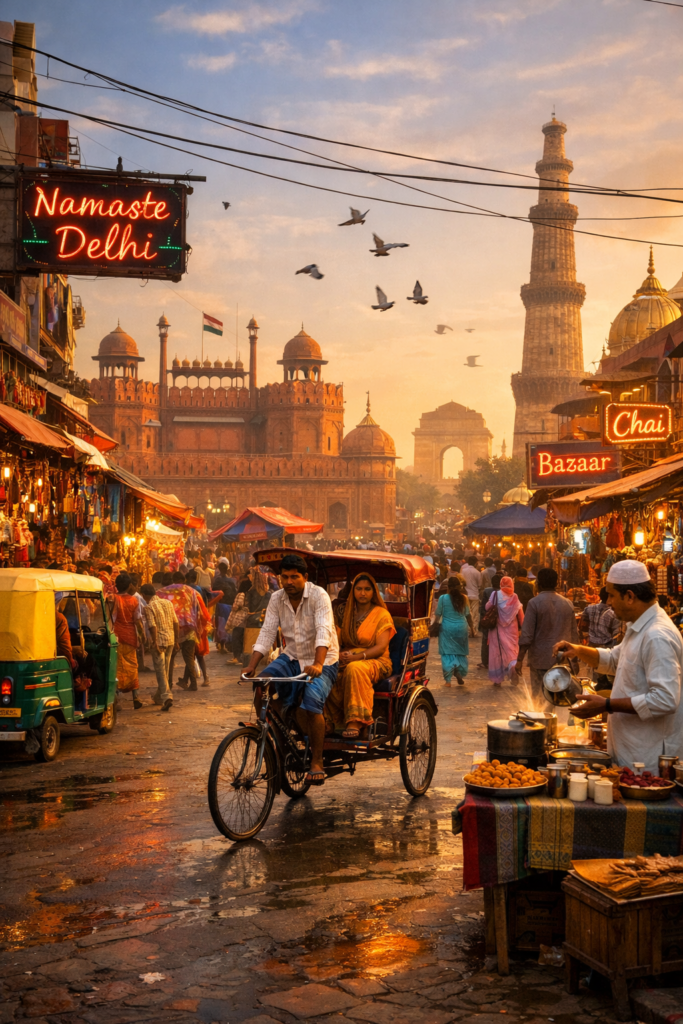
The Mughal era, in particular, had a lasting impact on Delhi’s culture, architecture, and lifestyle. Shahjahanabad, built by Emperor Shah Jahan, became the heart of Old Delhi and remains a bustling area even today. Narrow lanes, historic havelis, and traditional markets like Chandni Chowk offer a glimpse into the city’s past. Mughal influence is also evident in Delhi’s cuisine, language, and art, blending Persian, Central Asian, and Indian traditions into a unique cultural identity.
British rule marked another turning point in Delhi’s history. In 1911, the British shifted India’s capital from Calcutta to Delhi and began constructing New Delhi as a grand imperial city. Designed by architects Edwin Lutyens and Herbert Baker, New Delhi introduced wide boulevards, spacious gardens, and imposing government buildings. Landmarks such as Rashtrapati Bhavan, India Gate, and Parliament House reflect colonial architectural styles combined with Indian elements. When India gained independence in 1947, Delhi became the capital of a free nation and a symbol of democratic governance.
Culturally, Delhi is one of the most diverse cities in India. People from all states and regions have migrated here over the years, making it a true melting pot of languages, traditions, and lifestyles. Hindi and English are widely spoken, but Punjabi, Urdu, Bengali, Tamil, and many other languages can be heard across the city. Festivals such as Diwali, Eid, Christmas, Gurpurab, and Holi are celebrated with great enthusiasm, reflecting the city’s pluralistic spirit. This diversity is also visible in Delhi’s art, music, theater, and literature, which continue to thrive in both traditional and contemporary forms.
Delhi’s food culture is another major attraction. From street food to fine dining, the city offers an extraordinary range of flavors. Old Delhi is famous for its chaat, parathas, kebabs, and sweets, while areas like Connaught Place and South Delhi showcase global cuisines and modern culinary trends. Mughlai dishes, Punjabi flavors, and regional Indian foods coexist with international options, making Delhi a paradise for food lovers.
Economically, Delhi plays a crucial role in India’s growth. As the national capital, it is a hub for government services, diplomacy, education, and media. The city is home to numerous universities, research institutions, and think tanks, including Delhi University, Jawaharlal Nehru University, and several prestigious schools and colleges. Delhi is also an important center for commerce, information technology, real estate, and tourism. Its strategic location and extensive infrastructure contribute to its economic importance.
Modern Delhi is a city of contrasts. Skyscrapers, metro lines, shopping malls, and business districts exist alongside ancient monuments and traditional neighborhoods. The Delhi Metro has transformed urban mobility, connecting distant parts of the city and reducing travel time. At the same time, Delhi faces significant challenges, including air pollution, traffic congestion, population pressure, and social inequality. Addressing these issues is essential for the city’s sustainable development and the well-being of its residents.
Despite these challenges, Delhi continues to evolve and adapt. Its resilience lies in its ability to absorb change while preserving its identity. The city’s parks, cultural institutions, museums, and heritage sites offer spaces for reflection and learning. Places like Lodhi Gardens, National Museum, and India Habitat Centre highlight Delhi’s efforts to balance urban life with cultural preservation.
In conclusion, Delhi is more than just a capital city; it is a living chronicle of India’s history, culture, and aspirations. From ancient legends to modern governance, from crowded bazaars to grand avenues, Delhi captures the essence of India in all its complexity. Its past gives it depth, its diversity gives it energy, and its future holds immense promise. As a city that has witnessed the rise and fall of empires and continues to reinvent itself, Delhi remains a powerful symbol of continuity, change, and the enduring spirit of India.
Leave a Reply