Ayodhya: A City of Faith, History, and Cultural Continuity
Ayodhya is one of the most ancient and sacred cities of India, located on the banks of the Sarayu River in the present-day state of Uttar Pradesh. Revered for thousands of years, Ayodhya holds a unique place in Indian civilization as a center of religion, culture, and history. It is best known as the birthplace of Lord Rama, one of the most important figures in Hinduism, and is closely associated with the epic Ramayana. Over centuries, Ayodhya has evolved as a symbol of spiritual devotion, historical complexity, and cultural resilience.
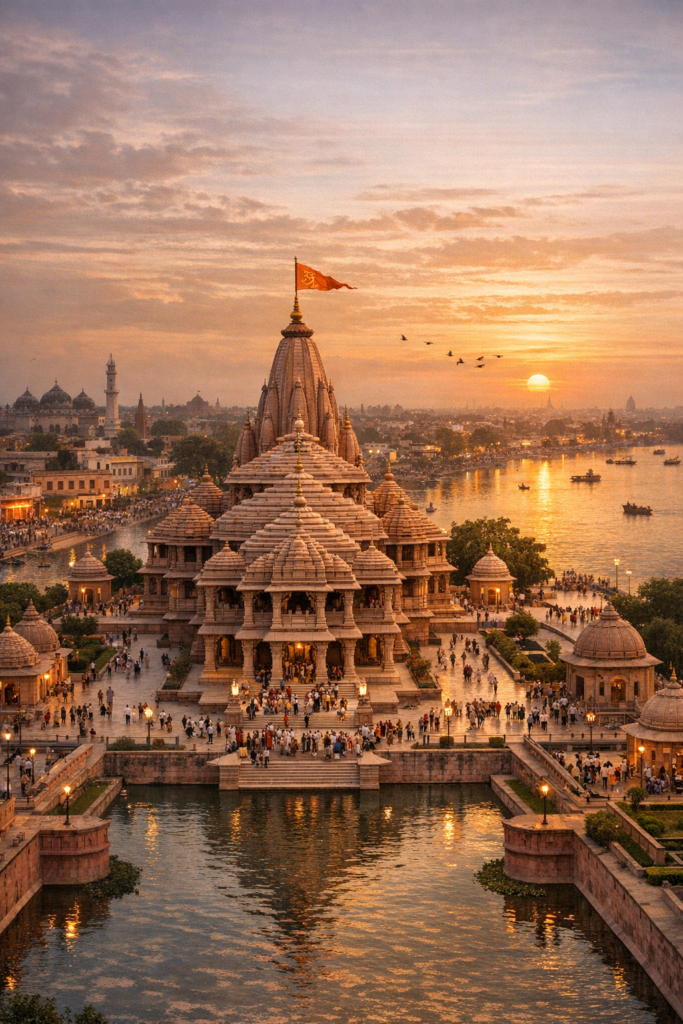
Historically, Ayodhya is believed to have been founded by Manu, the legendary lawgiver of Hindu tradition. In ancient times, it was known as Saketa and served as the capital of the Kosala kingdom. According to Hindu belief, Ayodhya was the capital ruled by King Dasharatha, the father of Lord Rama. The Ramayana, attributed to sage Valmiki, vividly describes Ayodhya as a prosperous, well-planned city filled with gardens, palaces, temples, and contented citizens. This depiction has deeply influenced Indian art, literature, and moral philosophy for centuries.
Ayodhya’s religious importance is not limited to Hinduism alone. It is also a significant site for Jainism and Buddhism. Jain tradition holds that five Tirthankaras, including the first Tirthankara Rishabhadeva, were born in Ayodhya. Buddhism flourished in and around the region during the Mauryan and Gupta periods, when monasteries and stupas were built. Thus, Ayodhya represents a confluence of multiple spiritual traditions, reflecting India’s pluralistic heritage.

During the medieval period, Ayodhya witnessed major political and cultural changes. With the arrival of Islamic rule in North India, new architectural and administrative influences emerged. The city continued to be an important religious center, though its political significance declined over time. The construction of the Babri Masjid in the 16th century by the Mughal general Mir Baqi became a focal point of historical and religious debate in later centuries. Despite periods of conflict and neglect, Ayodhya remained deeply rooted in the devotional practices of millions of people.
The modern history of Ayodhya has been shaped significantly by the Ram Janmabhoomi movement. The long-standing dispute over the site believed to be the birthplace of Lord Rama drew national and international attention. After decades of legal proceedings, the Supreme Court of India delivered a landmark verdict in 2019, paving the way for the construction of the Ram Mandir. The foundation stone was laid in 2020, marking a historic moment for many devotees. The development symbolizes not only religious fulfillment for Hindus but also a turning point in Ayodhya’s contemporary identity.


Culturally, Ayodhya is a living center of traditions, festivals, and rituals. Festivals such as Ram Navami, Diwali, and Makar Sankranti are celebrated with great enthusiasm. Diwali, in particular, holds special significance, as it commemorates the return of Lord Rama to Ayodhya after 14 years of exile. The city is illuminated with thousands of lamps, creating a spectacle that attracts visitors from across the world. The traditions of Ram Katha, bhajans, and classical performances continue to keep the spiritual legacy alive.
In recent years, Ayodhya has undergone rapid transformation. Infrastructure development, beautification of ghats, construction of new roads, and expansion of tourism facilities have reshaped the city. The aim is to develop Ayodhya as a global spiritual and cultural destination while preserving its ancient character. The Sarayu Riverfront, temples, ashrams, and heritage sites are being restored to reflect the city’s timeless spiritual aura.
In essence, Ayodhya is far more than a geographical location; it is an idea deeply embedded in the Indian consciousness. It represents ideals of dharma (righteousness), devotion, sacrifice, and moral governance embodied by Lord Rama. Through centuries of change, conflict, and renewal, Ayodhya has endured as a symbol of faith and continuity. Today, as it enters a new phase of development, Ayodhya stands as a bridge between ancient tradition and modern aspiration, reminding the world of India’s enduring spiritual and cultural legacy.
Here are 5 must-visit places in Ayodhya, a city rich in history, devotion, and culture:
- Shri Ram Janmabhoomi Mandir
This is the most sacred place in Ayodhya and believed to be the birthplace of Lord Ram. The grand temple is a symbol of faith and devotion and attracts millions of pilgrims from across the world. - Hanuman Garhi
A famous hilltop temple dedicated to Lord Hanuman. Devotees believe that visiting Hanuman Garhi before Ram Janmabhoomi brings blessings and protection. - Kanak Bhawan
A beautiful temple gifted to Mata Sita by Queen Kaikeyi. It is known for its stunning idols of Lord Ram and Mata Sita and peaceful atmosphere. - Saryu River & Ram Ki Paidi
The holy Saryu River is central to Ayodhya’s spiritual life. Ram Ki Paidi is a series of ghats where devotees take holy dips and enjoy the evening aarti. - Nageshwarnath Temple
An ancient temple dedicated to Lord Shiva, believed to have been established by Kush, the son of Lord Ram. It holds great importance during Mahashivratri.