Greenland: The World’s biggest Greenland: The World’s Largest Island
Greenland, the world’s largest island, is a vast and fascinating land of ice, mountains, fjords, and resilient cultures. Located between the Arctic and Atlantic Oceans, northeast of Canada and northwest of Iceland, Greenland covers an area of about 2.16 million square kilometers. Despite its immense size, it is one of the least densely populated places on Earth, with a population of around 56,000 people. Administratively, Greenland is an autonomous territory within the Kingdom of Denmark, but it has its own government and a strong cultural identity rooted in Inuit traditions and Arctic life.
Geography and Natural Features
Approximately 80 percent of Greenland is covered by the Greenland Ice Sheet, the second-largest body of ice in the world after Antarctica. This massive ice cap plays a crucial role in global climate systems and sea levels. In some places, the ice is more than three kilometers thick. Along the island’s coast, especially in the west and south, the land is ice-free and marked by deep fjords, rugged mountains, glaciers, and rocky coastlines.
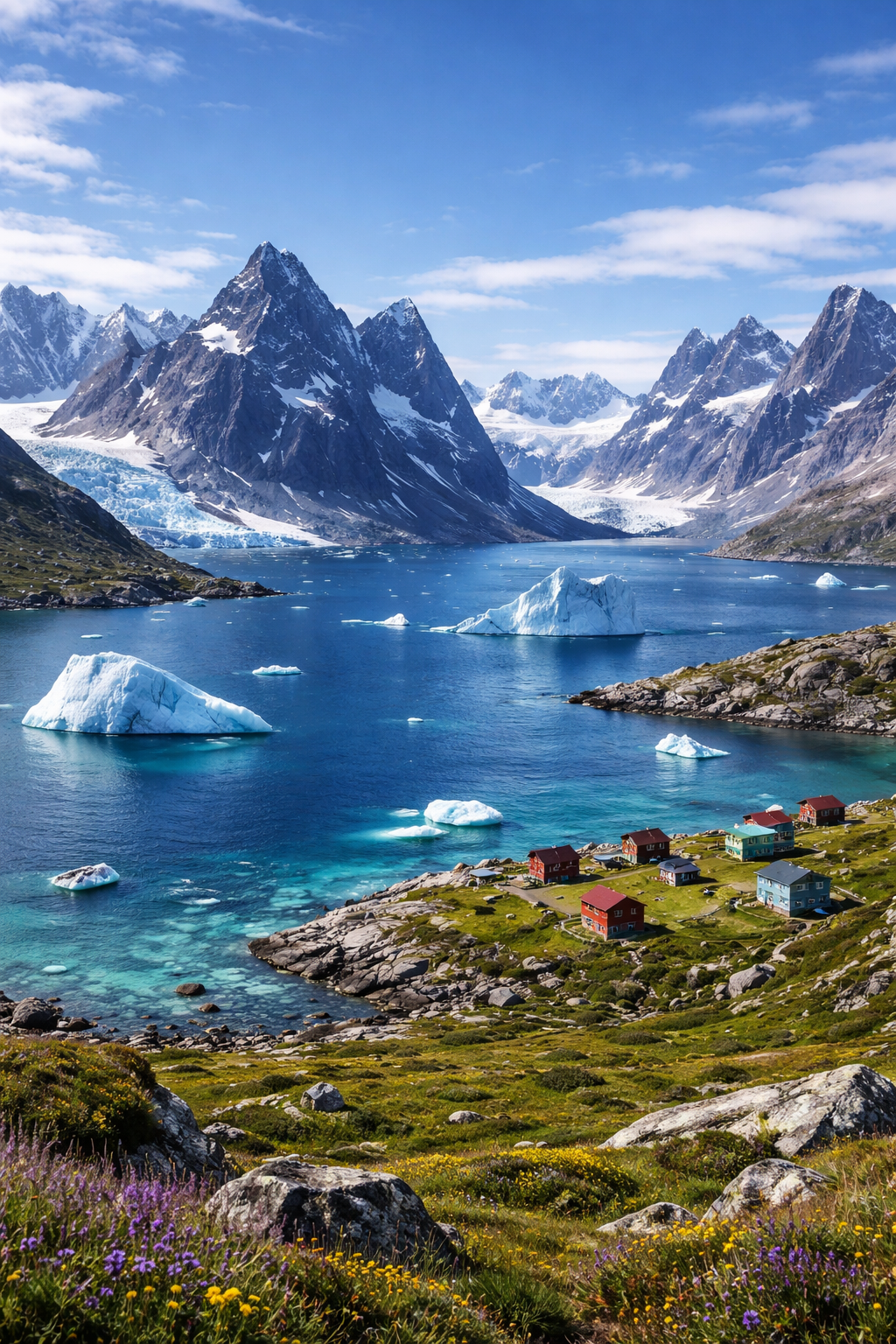
Greenland’s landscape is dramatic and diverse. Towering icebergs drift through icy waters, calved from glaciers that slowly move toward the sea. Fjords such as the Ilulissat Icefjord, a UNESCO World Heritage Site, showcase some of the most active and visually stunning glacier activity on Earth. In the far north and east, vast wilderness areas remain almost completely untouched by human presence, offering a glimpse into pristine Arctic ecosystems.
Climate and Environment
Greenland has an Arctic to sub-Arctic climate. Winters are long, dark, and extremely cold, particularly in the interior, while summers are short and cool. Coastal areas experience milder conditions due to ocean currents, especially in the southwest, where temperatures can occasionally rise above 10°C in summer. One of Greenland’s most striking natural phenomena is the polar night, when the sun does not rise for weeks or months in winter, and the midnight sun, when daylight lasts around the clock in summer.
Climate change has had a profound impact on Greenland. Rising global temperatures are causing rapid melting of glaciers and the ice sheet, contributing significantly to global sea-level rise. Scientists closely monitor Greenland because changes here provide critical insights into the future of Earth’s climate. At the same time, melting ice is revealing new land, altering ecosystems, and opening potential shipping routes and access to natural resources.
History and Early Settlement
Greenland’s human history dates back more than 4,500 years, when the first Paleo-Inuit cultures migrated from North America. Over time, various Inuit cultures developed, adapting skillfully to the harsh Arctic environment through hunting, fishing, and the use of animal skins and bones.
In the 10th century, Norse explorer Erik the Red led settlers from Iceland to Greenland, naming it “Greenland” in an attempt to attract colonists. The Norse established farming communities in southern Greenland, which lasted for several centuries before disappearing, likely due to climate cooling, economic isolation, and conflicts with the Inuit.
In the 18th century, Denmark re-established control over Greenland, and it remained a Danish colony until the mid-20th century. In 1979, Greenland gained home rule, followed by expanded self-government in 2009, allowing greater control over internal affairs and natural resources.
People and Culture
The majority of Greenland’s population is Inuit, known as Kalaallit, with Danish and other European minorities. The official language is Greenlandic (Kalaallisut), a member of the Inuit language family, while Danish and English are also widely spoken.
Greenlandic culture is deeply connected to nature. Traditional activities such as hunting seals, whales, and fishing remain important, both economically and culturally, especially in smaller settlements. Dog sledding, kayaking, and the use of traditional clothing made from animal skins reflect centuries-old practices adapted to Arctic life.
Art and storytelling play a vital role in Greenlandic culture. Carvings made from bone, tusk, and stone, along with modern visual arts, express connections to myths, spirits, and the natural world. Music, including drum dancing and contemporary genres, blends tradition with modern influences.
Economy and Way of Life
Greenland’s economy is relatively small and depends heavily on fishing, particularly shrimp and halibut, which account for the majority of exports. Hunting and small-scale agriculture play limited roles due to the climate, though sheep farming exists in southern Greenland.
Denmark provides substantial financial support to Greenland, forming an important part of the economy. However, there is ongoing debate about economic independence, with attention focused on the potential development of natural resources such as minerals, rare earth elements, oil, and gas. Tourism is also growing, as travelers are drawn by Greenland’s stunning landscapes, wildlife, and unique Arctic experiences.
Life in Greenlandic towns and settlements is shaped by isolation and close-knit communities. Many places are accessible only by boat or aircraft, as there are no roads connecting major towns. This isolation fosters strong social bonds but also presents challenges in healthcare, education, and infrastructure.
Wildlife and Biodiversity
Despite its harsh climate, Greenland supports a range of wildlife adapted to Arctic conditions. Land animals include polar bears, Arctic foxes, musk oxen, reindeer, and Arctic hares. The surrounding seas are rich in marine life, with seals, walruses, whales, and numerous fish species. Birdlife is abundant in summer, when millions of migratory birds nest along Greenland’s coasts and cliffs.
These ecosystems are sensitive to environmental change. Melting ice and warming seas affect animal migration patterns, breeding grounds, and food availability, making conservation efforts increasingly important.
Greenland in the Modern World
Today, Greenland stands at the intersection of tradition and modernity. While many residents embrace modern technology, education, and global connections, there is also a strong desire to preserve language, culture, and traditional knowledge. Greenland’s strategic location and natural resources have increased its geopolitical importance, attracting international interest from major world powers.
At the same time, Greenlanders continue to navigate questions of identity, sustainability, and self-determination. Balancing economic development with environmental protection is a central challenge, especially in a region so deeply affected by climate change.
Conclusion
Greenland is a land of extremes—vast ice sheets and deep fjords, long winters and bright summer nights, ancient traditions and modern aspirations. Its unique geography and culture make it one of the most remarkable places on Earth. As climate change reshapes its landscape and global interest in the Arctic grows, Greenland’s future will play an increasingly important role not only for its people, but for the planet as a whole.Greenland: The World’s Largest Island
Greenland, the world’s largest island, is a vast and fascinating land of ice, mountains, fjords, and resilient cultures. Located between the Arctic and Atlantic Oceans, northeast of Canada and northwest of Iceland, Greenland covers an area of about 2.16 million square kilometers. Despite its immense size, it is one of the least densely populated places on Earth, with a population of around 56,000 people. Administratively, Greenland is an autonomous territory within the Kingdom of Denmark, but it has its own government and a strong cultural identity rooted in Inuit traditions and Arctic life.
Geography and Natural Features
Approximately 80 percent of Greenland is covered by the Greenland Ice Sheet, the second-largest body of ice in the world after Antarctica. This massive ice cap plays a crucial role in global climate systems and sea levels. In some places, the ice is more than three kilometers thick. Along the island’s coast, especially in the west and south, the land is ice-free and marked by deep fjords, rugged mountains, glaciers, and rocky coastlines.
Greenland’s landscape is dramatic and diverse. Towering icebergs drift through icy waters, calved from glaciers that slowly move toward the sea. Fjords such as the Ilulissat Icefjord, a UNESCO World Heritage Site, showcase some of the most active and visually stunning glacier activity on Earth. In the far north and east, vast wilderness areas remain almost completely untouched by human presence, offering a glimpse into pristine Arctic ecosystems.
Climate and Environment
Greenland has an Arctic to sub-Arctic climate. Winters are long, dark, and extremely cold, particularly in the interior, while summers are short and cool. Coastal areas experience milder conditions due to ocean currents, especially in the southwest, where temperatures can occasionally rise above 10°C in summer. One of Greenland’s most striking natural phenomena is the polar night, when the sun does not rise for weeks or months in winter, and the midnight sun, when daylight lasts around the clock in summer.
Climate change has had a profound impact on Greenland. Rising global temperatures are causing rapid melting of glaciers and the ice sheet, contributing significantly to global sea-level rise. Scientists closely monitor Greenland because changes here provide critical insights into the future of Earth’s climate. At the same time, melting ice is revealing new land, altering ecosystems, and opening potential shipping routes and access to natural resources.
History and Early Settlement
Greenland’s human history dates back more than 4,500 years, when the first Paleo-Inuit cultures migrated from North America. Over time, various Inuit cultures developed, adapting skillfully to the harsh Arctic environment through hunting, fishing, and the use of animal skins and bones.
In the 10th century, Norse explorer Erik the Red led settlers from Iceland to Greenland, naming it “Greenland” in an attempt to attract colonists. The Norse established farming communities in southern Greenland, which lasted for several centuries before disappearing, likely due to climate cooling, economic isolation, and conflicts with the Inuit.
In the 18th century, Denmark re-established control over Greenland, and it remained a Danish colony until the mid-20th century. In 1979, Greenland gained home rule, followed by expanded self-government in 2009, allowing greater control over internal affairs and natural resources.
People and Culture
The majority of Greenland’s population is Inuit, known as Kalaallit, with Danish and other European minorities. The official language is Greenlandic (Kalaallisut), a member of the Inuit language family, while Danish and English are also widely spoken.
Greenlandic culture is deeply connected to nature. Traditional activities such as hunting seals, whales, and fishing remain important, both economically and culturally, especially in smaller settlements. Dog sledding, kayaking, and the use of traditional clothing made from animal skins reflect centuries-old practices adapted to Arctic life.
Art and storytelling play a vital role in Greenlandic culture. Carvings made from bone, tusk, and stone, along with modern visual arts, express connections to myths, spirits, and the natural world. Music, including drum dancing and contemporary genres, blends tradition with modern influences.
Economy and Way of Life
Greenland’s economy is relatively small and depends heavily on fishing, particularly shrimp and halibut, which account for the majority of exports. Hunting and small-scale agriculture play limited roles due to the climate, though sheep farming exists in southern Greenland.
Denmark provides substantial financial support to Greenland, forming an important part of the economy. However, there is ongoing debate about economic independence, with attention focused on the potential development of natural resources such as minerals, rare earth elements, oil, and gas. Tourism is also growing, as travelers are drawn by Greenland’s stunning landscapes, wildlife, and unique Arctic experiences.
Life in Greenlandic towns and settlements is shaped by isolation and close-knit communities. Many places are accessible only by boat or aircraft, as there are no roads connecting major towns. This isolation fosters strong social bonds but also presents challenges in healthcare, education, and infrastructure.
Wildlife and Biodiversity
Despite its harsh climate, Greenland supports a range of wildlife adapted to Arctic conditions. Land animals include polar bears, Arctic foxes, musk oxen, reindeer, and Arctic hares. The surrounding seas are rich in marine life, with seals, walruses, whales, and numerous fish species. Birdlife is abundant in summer, when millions of migratory birds nest along Greenland’s coasts and cliffs.
These ecosystems are sensitive to environmental change. Melting ice and warming seas affect animal migration patterns, breeding grounds, and food availability, making conservation efforts increasingly important.
Greenland in the Modern World
Today, Greenland stands at the intersection of tradition and modernity. While many residents embrace modern technology, education, and global connections, there is also a strong desire to preserve language, culture, and traditional knowledge. Greenland’s strategic location and natural resources have increased its geopolitical importance, attracting international interest from major world powers.
At the same time, Greenlanders continue to navigate questions of identity, sustainability, and self-determination. Balancing economic development with environmental protection is a central challenge, especially in a region so deeply affected by climate change.
Conclusion
Greenland is a land of extremes—vast ice sheets and deep fjords, long winters and bright summer nights, ancient traditions and modern aspirations. Its unique geography and culture make it one of the most remarkable places on Earth. As climate change reshapes its landscape and global interest in the Arctic grows, Greenland’s future will play an increasingly important role not only for its people, but for the planet as a whole.Island
Greenland, the world’s largest island, is a vast and fascinating land of ice, mountains, fjords, and resilient cultures. Located between the Arctic and Atlantic Oceans, northeast of Canada and northwest of Iceland, Greenland covers an area of about 2.16 million square kilometers. Despite its immense size, it is one of the least densely populated places on Earth, with a population of around 56,000 people. Administratively, Greenland is an autonomous territory within the Kingdom of Denmark, but it has its own government and a strong cultural identity rooted in Inuit traditions and Arctic life.
Geography and Natural Features
Approximately 80 percent of Greenland is covered by the Greenland Ice Sheet, the second-largest body of ice in the world after Antarctica. This massive ice cap plays a crucial role in global climate systems and sea levels. In some places, the ice is more than three kilometers thick. Along the island’s coast, especially in the west and south, the land is ice-free and marked by deep fjords, rugged mountains, glaciers, and rocky coastlines.
Greenland’s landscape is dramatic and diverse. Towering icebergs drift through icy waters, calved from glaciers that slowly move toward the sea. Fjords such as the Ilulissat Icefjord, a UNESCO World Heritage Site, showcase some of the most active and visually stunning glacier activity on Earth. In the far north and east, vast wilderness areas remain almost completely untouched by human presence, offering a glimpse into pristine Arctic ecosystems.
Climate and Environment
Greenland has an Arctic to sub-Arctic climate. Winters are long, dark, and extremely cold, particularly in the interior, while summers are short and cool. Coastal areas experience milder conditions due to ocean currents, especially in the southwest, where temperatures can occasionally rise above 10°C in summer. One of Greenland’s most striking natural phenomena is the polar night, when the sun does not rise for weeks or months in winter, and the midnight sun, when daylight lasts around the clock in summer.
Climate change has had a profound impact on Greenland. Rising global temperatures are causing rapid melting of glaciers and the ice sheet, contributing significantly to global sea-level rise. Scientists closely monitor Greenland because changes here provide critical insights into the future of Earth’s climate. At the same time, melting ice is revealing new land, altering ecosystems, and opening potential shipping routes and access to natural resources.
History and Early Settlement
Greenland’s human history dates back more than 4,500 years, when the first Paleo-Inuit cultures migrated from North America. Over time, various Inuit cultures developed, adapting skillfully to the harsh Arctic environment through hunting, fishing, and the use of animal skins and bones.
In the 10th century, Norse explorer Erik the Red led settlers from Iceland to Greenland, naming it “Greenland” in an attempt to attract colonists. The Norse established farming communities in southern Greenland, which lasted for several centuries before disappearing, likely due to climate cooling, economic isolation, and conflicts with the Inuit.
In the 18th century, Denmark re-established control over Greenland, and it remained a Danish colony until the mid-20th century. In 1979, Greenland gained home rule, followed by expanded self-government in 2009, allowing greater control over internal affairs and natural resources.
People and Culture
The majority of Greenland’s population is Inuit, known as Kalaallit, with Danish and other European minorities. The official language is Greenlandic (Kalaallisut), a member of the Inuit language family, while Danish and English are also widely spoken.
Greenlandic culture is deeply connected to nature. Traditional activities such as hunting seals, whales, and fishing remain important, both economically and culturally, especially in smaller settlements. Dog sledding, kayaking, and the use of traditional clothing made from animal skins reflect centuries-old practices adapted to Arctic life.
Art and storytelling play a vital role in Greenlandic culture. Carvings made from bone, tusk, and stone, along with modern visual arts, express connections to myths, spirits, and the natural world. Music, including drum dancing and contemporary genres, blends tradition with modern influences.
Economy and Way of Life
Greenland’s economy is relatively small and depends heavily on fishing, particularly shrimp and halibut, which account for the majority of exports. Hunting and small-scale agriculture play limited roles due to the climate, though sheep farming exists in southern Greenland.
Denmark provides substantial financial support to Greenland, forming an important part of the economy. However, there is ongoing debate about economic independence, with attention focused on the potential development of natural resources such as minerals, rare earth elements, oil, and gas. Tourism is also growing, as travelers are drawn by Greenland’s stunning landscapes, wildlife, and unique Arctic experiences.
Life in Greenlandic towns and settlements is shaped by isolation and close-knit communities. Many places are accessible only by boat or aircraft, as there are no roads connecting major towns. This isolation fosters strong social bonds but also presents challenges in healthcare, education, and infrastructure.
Wildlife and Biodiversity
Despite its harsh climate, Greenland supports a range of wildlife adapted to Arctic conditions. Land animals include polar bears, Arctic foxes, musk oxen, reindeer, and Arctic hares. The surrounding seas are rich in marine life, with seals, walruses, whales, and numerous fish species. Birdlife is abundant in summer, when millions of migratory birds nest along Greenland’s coasts and cliffs.
These ecosystems are sensitive to environmental change. Melting ice and warming seas affect animal migration patterns, breeding grounds, and food availability, making conservation efforts increasingly important.
Greenland in the Modern World
Today, Greenland stands at the intersection of tradition and modernity. While many residents embrace modern technology, education, and global connections, there is also a strong desire to preserve language, culture, and traditional knowledge. Greenland’s strategic location and natural resources have increased its geopolitical importance, attracting international interest from major world powers.
At the same time, Greenlanders continue to navigate questions of identity, sustainability, and self-determination. Balancing economic development with environmental protection is a central challenge, especially in a region so deeply affected by climate change.
Conclusion
Greenland is a land of extremes—vast ice sheets and deep fjords, long winters and bright summer nights, ancient traditions and modern aspirations. Its unique geography and culture make it one of the most remarkable places on Earth. As climate change reshapes its landscape and global interest in the Arctic grows, Greenland’s future will play an increasingly important role not only for its people, but for the planet as a whole.
Leave a Reply